
A daily loss limit is the most you allow yourself to lose in one trading day. When you hit it, you stop: no “one more trade,” no trying to win it back before the close. Independent traders choose their own number. Funded-account programs impose theirs, and breaking it usually ends the account. This guide covers how to pick the figure, how the measuring rules can catch you out, and how to build the habit of honoring it.
TL;DR
- A daily loss limit is a preset cap on one day’s losses. Once it is reached, you stop trading until the next session.
- A common range is 2% to 5% of the account for a self-funded trader, and many professionals sit at the low end. A survey of 34 funded programs found 3% to be the most common daily limit.
- Check how the limit is measured (balance, equity, or the higher of the two) and when it resets. Both vary by firm.
- Treat the limit as a trigger, not a guaranteed ceiling. Slippage can push the real loss past it.
- Log every limit hit and what led to it. The pattern in those days tells you more than the number does.
Table of Contents
- What a daily loss limit actually is
- Why a hard stop works
- How to choose your number
- The measurement traps
- What about the pattern day trader rule?
- Perspective: why the limit belongs in your journal
- Track the limit with a journal, not memory
- Where SpiceLog fits
- Common mistakes with daily loss limits
- FAQ
- Sources
What a daily loss limit actually is
The definition is simple. A daily loss limit (sometimes called a max daily loss rule or a daily drawdown limit) is a predefined threshold that ends your session once your losses for the day reach it. It can be a dollar figure or a percentage of account equity.
Where it comes from matters, because the consequences differ:
- Self-imposed. You set it in your trading plan and enforce it yourself, or through a broker feature. Nothing happens if you ignore it except the damage to your account and your discipline.
- Broker-enforced. Some platforms let you lock the account automatically. NinjaTrader’s risk settings, for example, can lock an account once a daily or weekly loss threshold is reached.
- Funded-program rules. In most funded trader evaluations the limit is mandatory, and a breach typically means immediate and permanent disqualification.
The logic is the same in all three. A bad day is survivable. A bad day followed by a revenge-trading spiral is the one that ends accounts.
Why a hard stop works
Most large losses do not come from a single bad idea. They come from the third, fourth and fifth trade after the first loss, when you are sizing up to get back to even and your plan has quietly gone out the window.
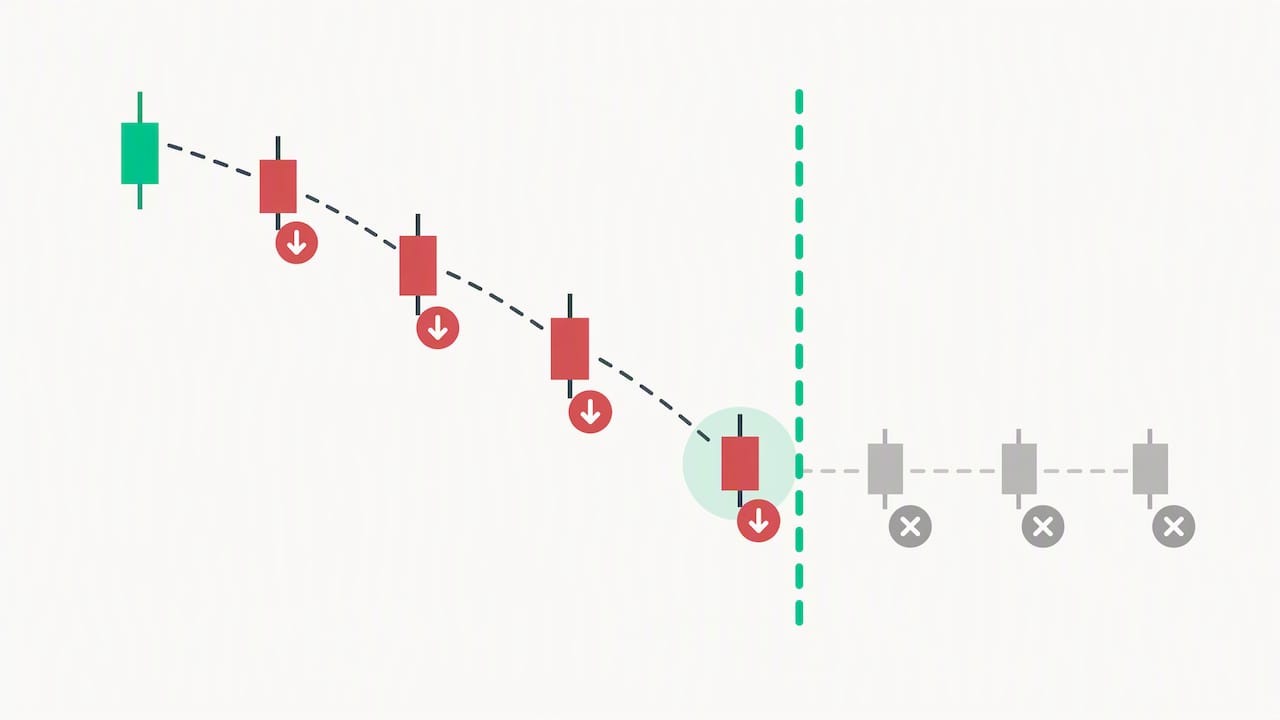
CME Group’s education team frames the 2% rule and daily loss limits as capital preservation. The exact percentage matters less than choosing a number you can accept psychologically and then following it without exceptions. That is the point most traders miss: a limit you override is not a limit.
It also helps to change what hitting the limit means. A futures trading help center describes automated lock-outs as a protective mechanism rather than a failure, and the idea carries over to any account. You were wrong today, the system caught it, and tomorrow you start with most of your capital and a clearer head.
How to choose your number
There is no universal right answer, but there is a sensible process.
Start from risk per trade
If you risk 1% of the account on a trade, a 3% daily limit means three full losers end your day. A 2% limit means two. Work backward from how many consecutive losses you can take before your decisions get worse. For many people that is two or three, not six.
For reference, the widely repeated range is 2% to 5% of account balance. Pipster’s drawdown database found 3% the most common daily limit, at 14 of the 34 programs that have one. That tells you what funded programs allow, not what is best for your own account. Self-funded traders can and often should be tighter.
A worked example
Say you trade a $40,000 account and risk 0.5% per trade, or $200.
| Setting | Dollar amount | What it means |
|---|---|---|
| Risk per trade (0.5%) | $200 | Your standard stop distance times size |
| Daily limit (1.5%) | $600 | Three full losers ends the day |
| Daily limit (3%) | $1,200 | Six full losers ends the day |
Six consecutive full losers in one morning is not a day of trading. It is a day of something else. For most discretionary traders the tighter row is the honest one. If you are unsure, start there and loosen it only after your journal shows you stay disciplined deep into a losing day.
Build a buffer under any hard limit
If you trade under a firm’s limit, do not aim for that number. One guide for self-funded traders recommends setting your own manual limit well below the maximum, so gaps and slippage do not take you through the floor. The CMC Funded academy makes the same point about challenges: a trading plan should keep you far enough from the daily loss limit that one bad stretch cannot breach it.
A practical version: if the program’s limit is $2,000, set a personal stop at $1,200 or $1,000. The program’s number is the cliff edge. Yours is the fence well before it.
Size positions to match
The limit only works if each trade’s risk fits inside it. If one stop-out costs half your daily allowance, you have a limit in name only. Our position size calculator turns your account size, risk percentage and stop distance into a share count, so the size of each trade is set by the plan rather than by how confident you feel.
The measurement traps
Two accounts can both say “3% daily loss limit” and behave very differently. Before you trade, find answers to these questions in your firm’s or broker’s rules.
Realized versus floating losses
Many traders assume only closed losses count. In practice, especially with funded accounts, the limit is often measured by equity, so open positions that are down count against you even if you never close them. You can breach the limit while still holding a trade that you think will come back.
What the limit is measured from
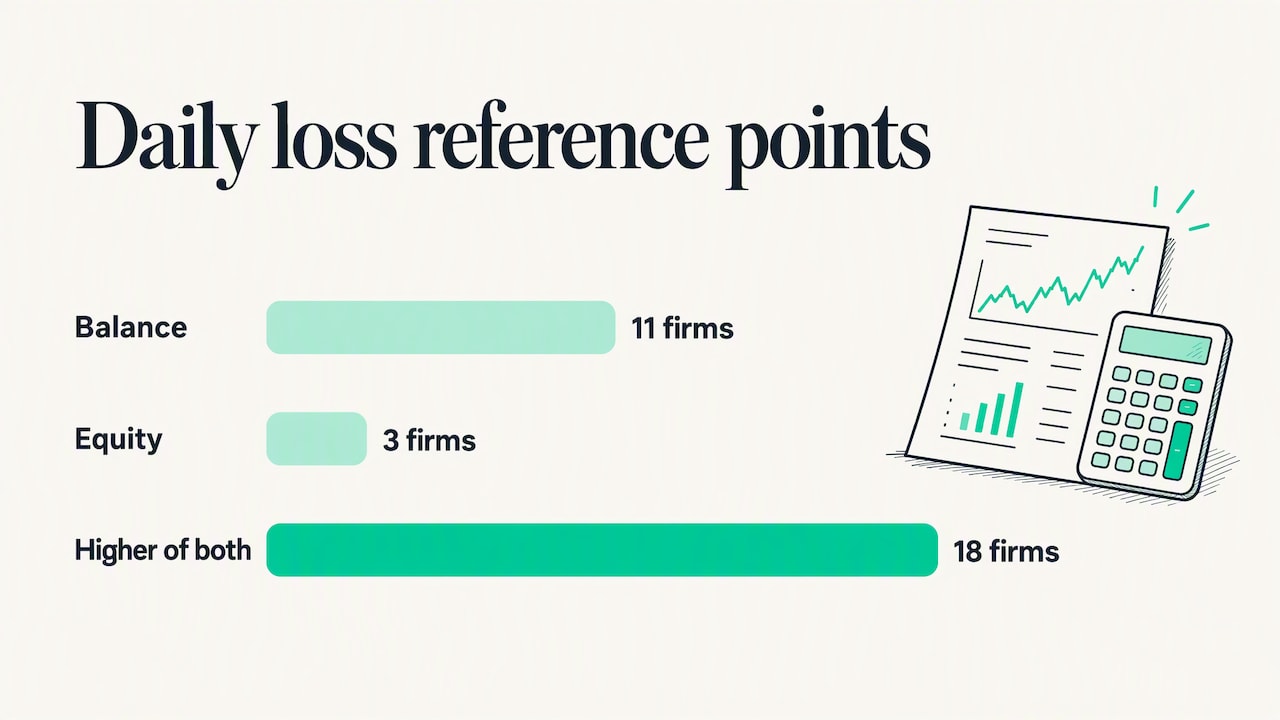
The starting point varies: start-of-day balance, equity, or the higher of the two. In Pipster’s data, among firms that state the reference point, 11 use balance, 3 use equity and 18 use the higher of the two. The higher-of-the-two version has a catch. Profits made early in the day do not necessarily buy you a bigger cushion later, and some rules can even leave you with less room than you assumed. CMC Funded’s academy flags this calculation hazard and says to verify whether intraday gains are counted.
When the day resets
There is no standard reset. Common times include 00:00 UTC, 5:00 PM Central, or a platform’s server time. One funded-program help page lists a 3% to 5% daily limit that resets at 00:00, which is a different clock from a futures session that rolls over in the evening. If you get the reset time wrong, your running total for the session is wrong too, and you may think you have room when you do not.
Slippage on the way out
When a limit triggers an automatic flatten, the exit is typically a market order. In a fast market it can fill at a worse price than you expected. NinjaTrader’s documentation on risk settings is a useful example of how these lockouts work, and the lesson applies broadly: treat the limit as a trigger for action, not a guarantee that you will lose no more than the number. That is another reason for your own buffer.
Percentage versus fixed dollars
Some programs set the limit as a share of the initial balance, such as 4% of the initial account balance in one two-step evaluation. That means the dollar figure does not shrink if the account falls. Others use a fixed dollar amount that does not adjust during the session. Read which one you are on.
What about the pattern day trader rule?
People searching for a daily loss limit often also ask about the $25,000 rule, and the answer changed recently. According to FINRA Regulatory Notice 26-10, the pattern day trader framework, including the $25,000 minimum equity requirement and day-trade count limits, has been replaced by new intraday margin standards under amendments to Rule 4210, with member firms given until October 20, 2027 to phase them in.
Two cautions follow from that. First, your broker may still be running its own transition, so confirm how it applies to your account today. Second, and more relevant here: fewer restrictions on how many day trades you can place make a self-imposed limit more important, not less. The old rule capped your activity by accident. A daily loss limit caps it on purpose.
Perspective: why the limit belongs in your journal
We built SpiceLog around one idea: a trade fill is only useful once you can see what it says about your behavior. A daily loss limit is a good example. The rule is easy to write down. The hard part is knowing, honestly, how often you break it and what is going on when you do.
In our view, the number you pick matters less than three habits around it.
- Write the limit before the open, in dollars. A percentage in your head is easy to renegotiate at 10:40 a.m. when you are down. A dollar figure on a note next to your screen is harder to argue with.
- Treat every hit as data. When the limit triggers, tag the trades from that day. Was it oversizing, chasing, trading outside your setups, or a market that simply did not suit your strategy? Over a month, the tags show you which of those is costing you the most.
- Review the days you stopped on time, too. Stopping when you should is a skill. Seeing how a limit-day ended, and what the next day looked like, is how you learn to trust the rule.
A day with a hit limit and a clean exit is a good day for process, even when it is a red day for P&L. If your journal only celebrates green days, it will quietly teach you the wrong lesson.
— Monte
Track the limit with a journal, not memory
A limit you only track in your head fails at the worst moment. Here is a simple routine that works with any broker.
- Before the session: write down your account value, your dollar limit and your reset time.
- During the session: check your running day total after each trade, not each hour. Include open positions if your rule is equity-based.
- At the limit: close the platform or lock the account. Do not leave positions open as a loophole unless your rules allow it.
- After the session: log the trades, tag mistakes, and write two lines about what happened in the last three trades before you stopped.
- Weekly: count limit hits, average loss on those days, and the tags that show up most. Our piece on a weekly trade review for day traders lays out a structure for this.
Measuring losses in R, a multiple of your initial risk, also makes the limit easier to reason about. A limit of 3R means three full-risk losers, whatever the account size. We cover the method in R-multiples for day traders.
Where SpiceLog fits
SpiceLog is a free trading journal for U.S. stock and ETF traders. It imports your fills from brokers and platforms including DAS Trader Pro, Interactive Brokers, Schwab, thinkorswim, Tradervue and PropReports, then builds reports on win rate, profit factor, drawdown and expectancy. Daily profit summaries and an interactive calendar make your worst days easy to spot, and custom tags let you label the mistake behind each one. All features are free, with no locked reports.
If you trade on DAS, start with how to export your DAS Trader Pro trade log, then open the free journal and import it. Prefer to start in a spreadsheet? There is also a free trading journal template for Excel and Google Sheets.
Common mistakes with daily loss limits
- Moving the limit mid-day. If you raise it after you are down, you do not have a limit.
- Setting it at the program’s maximum. That leaves no room for slippage or a miscalculated reset.
- Ignoring floating losses. If your rule counts equity, so should your tracking.
- Switching to another account or market to keep trading. That is the same impulse under a different login.
- Never reviewing hit days. Without review, the limit protects your account but teaches you nothing.
- Setting a limit that is too tight to survive normal variance. If you hit it every other day on ordinary losses, your size is too big for your stop distance, not your limit too small.
FAQ
What is a daily loss limit?
It is the maximum amount you will lose in one trading day before you stop. It can be a dollar figure or a percentage of account equity. Funded programs enforce it for you, while self-funded traders enforce it themselves.
What happens if you go over your daily loss limit?
It depends on who set it. In most funded evaluations, a breach leads to immediate and permanent disqualification. On your own account, nothing automatic happens unless you use a broker lockout, which is why a written rule and a review habit matter.
What time does the daily loss limit reset?
There is no standard. Reset times range from midnight UTC to 5:00 PM Central or a platform’s server time. Check your firm’s or broker’s rules and set your own tracking to the same clock.
Is there still a $25,000 day trading rule?
FINRA has replaced the pattern day trader rules, including the $25,000 minimum, with intraday margin standards, per Regulatory Notice 26-10. Member firms have until October 20, 2027 to phase in the change, so ask your broker what applies to your account now.
How much should my daily loss limit be?
A common range is 2% to 5% of the account, and a survey of funded programs found 3% most common. Self-funded traders often do better lower, such as 1% to 2%, and tied to how many full-risk losers they can take before their judgment slips. This is general education, not personal advice.
Sources
- FINRA Regulatory Notice 26-10
- Daily Loss Limit Calculator (BestProps)
- Drawdown Database (Pipster)
- CME Group: The 2 Percent Rule
- Daily Loss Limit help article (Topstep Help Center)
- Risk Settings (NinjaTrader Support)
- Daily Loss Limit Guide (TraderCalcPro)
- Write a trading plan that fits your limits (CMC Funded)
- Daily loss limit (Atlas Funded Help Center)
- 2 Step Pro V2 Daily Loss Limit (Top One Trader Help Center)


Leave a Reply